
Sense Of Agency
Service touchpoints encouraging regenerative and resilient train travel experiences for people's everyday mobility
Service Design
Participatory Design
Collaboration with Norrtåg and BioFuel Region
DETAILS
General Product Design @ Umeå Institute of Design
TEAM
Pola Kołodziej, Kacper Skup-Prochownik
MY ROLE
Research, Concept, Co-Creation, Experience Prototyping
TIMELINE
10 weeks - 2026
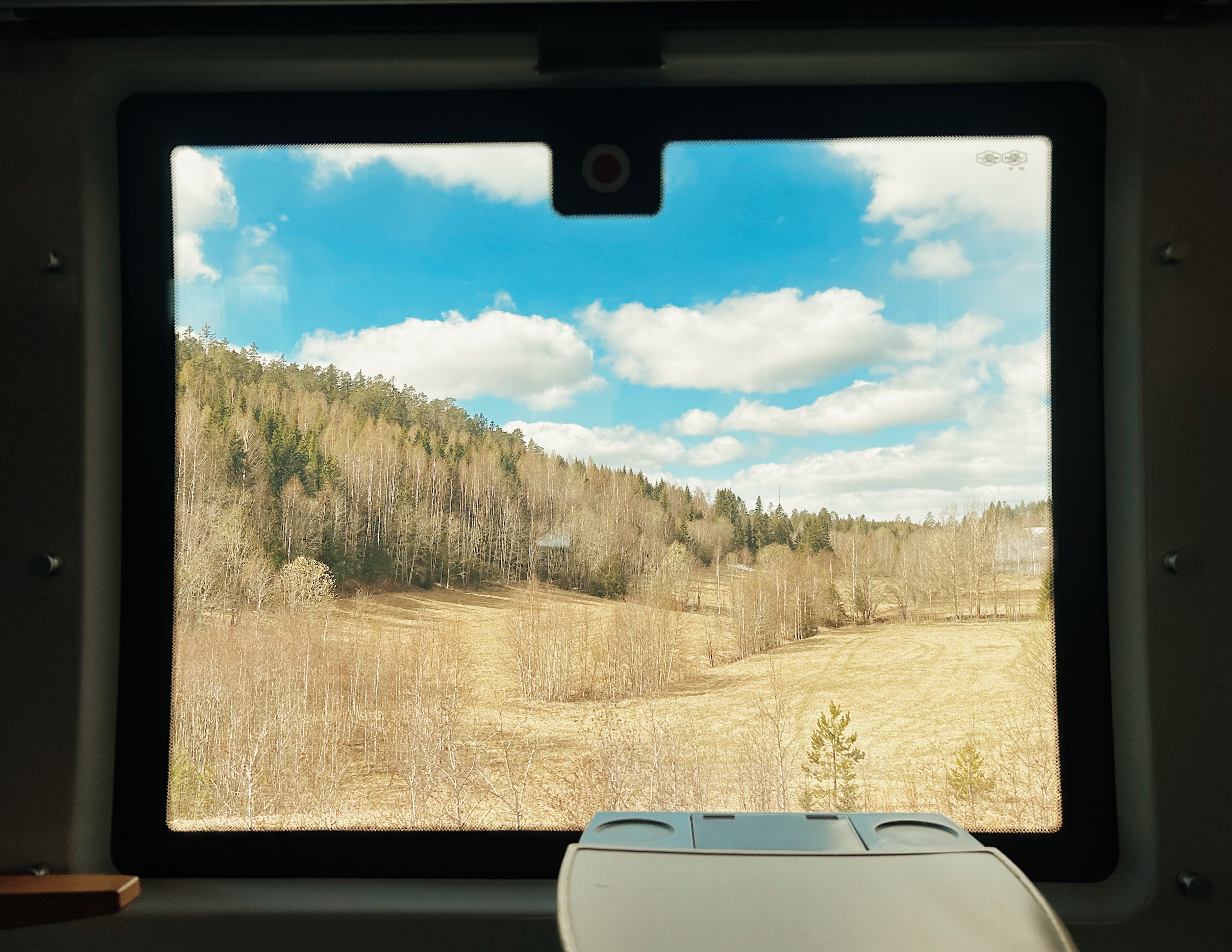
Context
Norrtåg is a regional train operator connecting passengers across Sweden’s four northernmost regions, covering approximately 224,000 km² of long distances, sparse populations, and contrasting climates.
For most travellers, the train is only one part of a longer journey. Cycling, buses, cars, and walking all play a role before and after. The question Norrtåg brought to us was about the bigger picture, that invited 'bold' ideas.
Challenge
How can the train become an attractive hub in people’s everyday mobility, in combination with other modes of transport?


Field Research & Approach
To design for everyday train travellers, we first had to understand the circumstances under which people chose to use the train at all. Work, study, leisure, necessity, the reasons were as varied as the people themselves.
We built a bespoke interview toolkit for use on trains and at stations: probes, interactive note-taking tools, and consent documentation designed to support efficient, respectful research in motion. Using active interviewing methods, we conducted 13 ethnographic interviews with Norrtåg passengers, letting participants shape the conversation as much as respond to it.
From these interviews, we synthesised two personas whose stories were built from fragments of the 13 real journeys we’d heard. An interactive journey map brought their experiences to life, grounding the design process in the nuanced realities of people who travel frequently and have quietly learned to make things work.
The goal throughout: to earn the right to design for the general public without flattening the richness of what we found. Because when you design for everyone too broadly, you end up designing for no one.
Defining Everyday Mobility
What the journey map revealed wasn’t just friction, but resilience. At almost every difficult moment in a journey, the people we spoke to had developed their own workarounds. Informal, personal, often invisible strategies for retaining a sense of control over their own travel. The pattern of silently adapting became the conceptual core of the project.
Reflection
Working on Oro opened up the world of sound design to me, and revealed its potential in shaping the experience of a form. It developed my skill in creating sounds and deepened my understanding of what makes a product feel cohesive, along with the system that surrounds it.
It also gave me the opportunity to explore a context I'd long wanted to engage with. Designing for dementia care pushed me to think carefully about what 'support' really means and why it's definition matters enormously when autonomy is already fragile.
If I were to revisit Oro, I'd invest more time in testing it and developing the concept further. Owing to the timeline of the project, we didn’t get the opportunity to actually test out the concept. The caregiver facing app was conceived as a setup tool, but it's the interface through which a family member translates their loved one's life into a system. That deserves its own design attention.


